
July 26, 2026
How to Keep Refill Information Organized When You Manage Multiple Chronic Prescriptions
📌 Key Takeaways
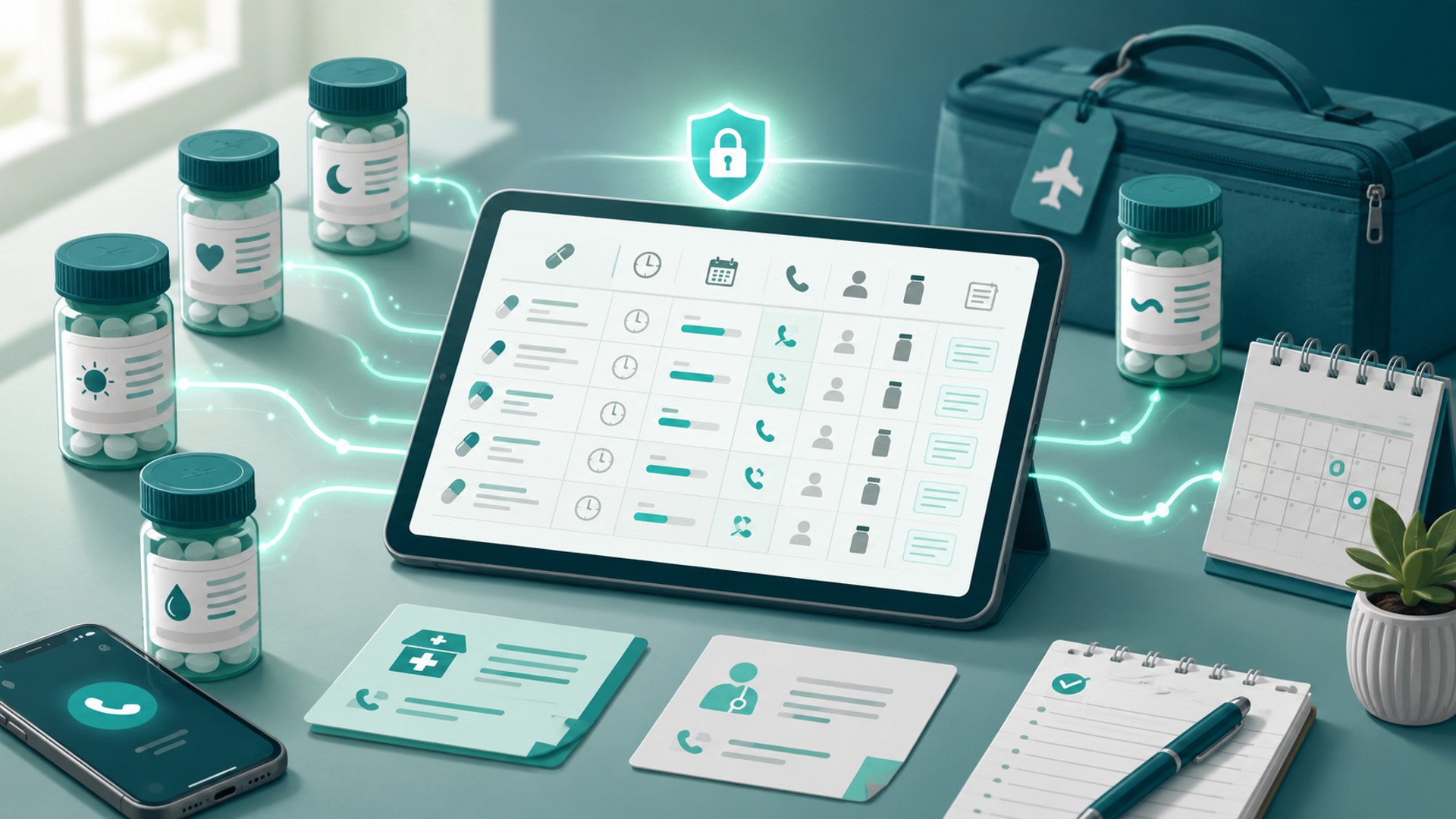
The author recommends keeping one secure refill tracker so chronic prescriptions stay clear before refill questions become urgent.
-
Use One Tracker: One refill tracker keeps bottles, apps, portals, and memory from pulling medication details apart.
-
Copy Current Records: Current labels and pharmacy records give safer details than memory during busy weeks.
-
Plan Before Disruptions: Review refill dates, contacts, and questions before travel, deadline weeks, moves, or provider changes.
-
Keep Contacts Together: Pharmacy, prescriber, appointment, and payment notes help refill questions move faster.
-
Know Online Limits: Organized details can help online refill reviews, but approval still depends on clinician review.
One secure tracker prevents last-minute refill confusion.
Adults managing several long-term prescriptions will reduce refill stress, preparing them for the refill organization steps below.
Refill confusion often shows up at the least convenient time: before a work trip, during a packed week, or when several prescriptions have different refill dates. One bottle may be nearly empty, another may have no clear refill date, and the pharmacy app may not show the prescriber details needed for the next question.
The fix is simple: keep refill details in one secure place before the next request. The goal is not to manage treatment independently, but to help a pharmacist, prescriber, or licensed refill-review clinician understand your refill question quickly.
This guide focuses on refill readiness for adults managing more than one maintenance medication. A maintenance medication generally means a prescription taken on an ongoing basis for a chronic or long-term condition, as directed by a healthcare provider.
Why Multiple Chronic Prescriptions Become Hard to Track
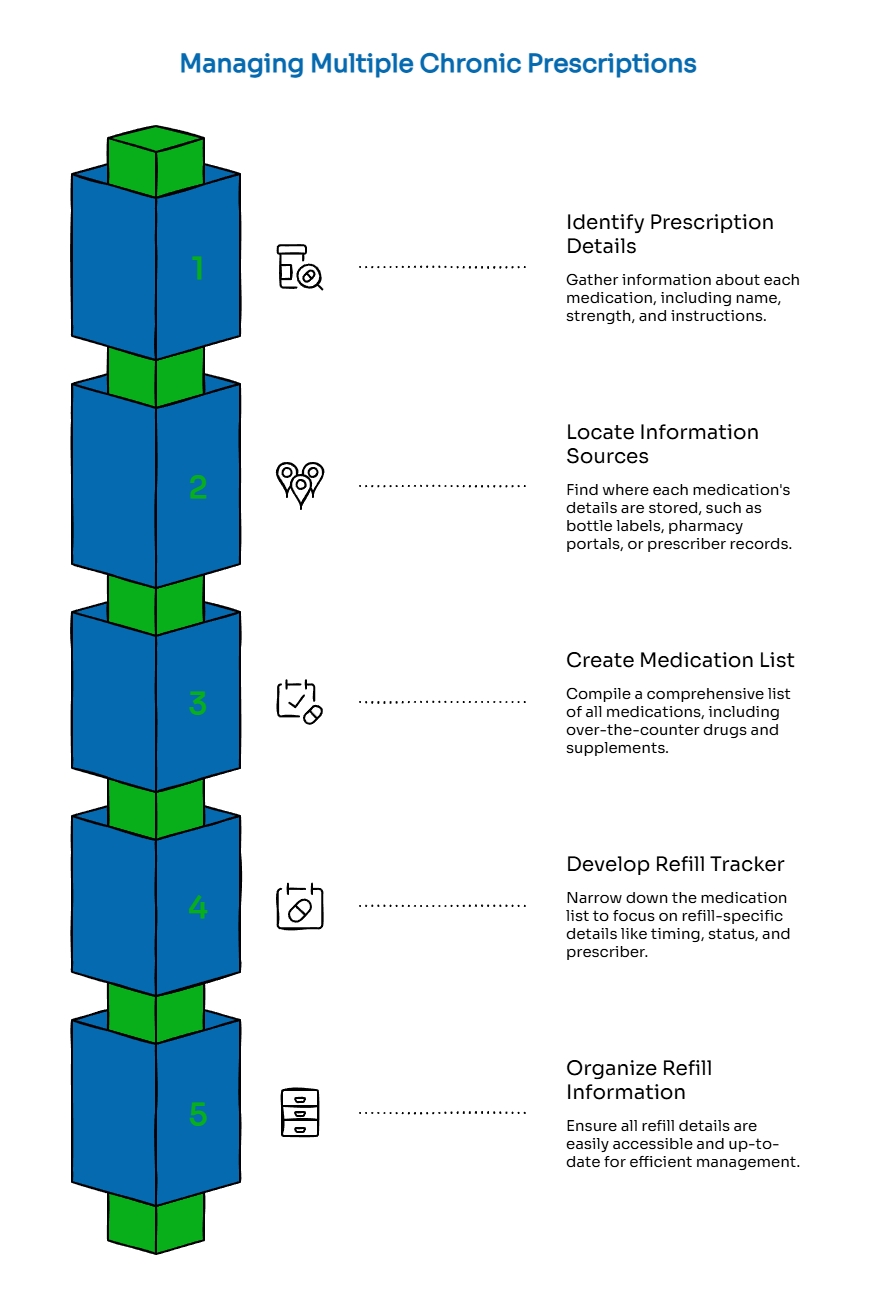
A single prescription is easy to remember, but several create a moving set of refill dates, bottle quantities, prescribers, directions, and update points.
These details often live in different places. One medication may be easiest to confirm from the bottle label. Another may be listed in a pharmacy portal. A third may depend on a prescriber’s office record or a recent appointment note.
The FDA describes a medication list as a tool that helps track prescription medications, over-the-counter drugs, vitamins, and supplements, and says a list should include details such as medication names, strengths, and instructions. That supports the general principle behind keeping an updated medication record, although refill timing still depends on the specific prescription and pharmacy situation.
A refill tracker narrows a general medication list into the details needed before a refill conversation: medication identity, directions, indication, refill status, prescriber, pharmacy, and timing.
Build One Refill Information Tracker for Every Medication
Use one tracker for every ongoing prescription, not only the one that usually runs out first. Copy the details from the current label, pharmacy record, or prescriber record. Memory can be incomplete during a busy week, especially when brand and generic names differ.
AHRQ’s medicine-list guidance recommends gathering information for all medicines and recording details such as name, strength, and instructions. It also notes that brand and generic names may both be useful to record.
| Field | What to Record | Why It Matters |
|---|---|---|
| Medication name | Brand and generic name, if both are available | Helps avoid confusion across labels, portals, and clinician notes |
| Reason for taking / indication | The condition or purpose listed in the record or explained by the clinician, if known | Helps clarify which prescription is being discussed when several medications have similar names or overlapping records |
| Strength/form | Strength and form as listed on the current bottle or record | Gives the pharmacist or clinician the correct reference point |
| Directions | Current directions as shown on the prescription label | Avoids relying on memory when answering refill questions |
| Prescriber | Name, office phone number, portal, and next appointment date if known | Helps resolve questions when refill status is unclear |
| Pharmacy | Name, phone number, address, and app or login location if relevant | Keeps coordination details easy to find |
| Refills remaining | What the bottle, pharmacy app, or pharmacy staff confirms | Helps identify whether a refill may already be available |
| Last filled / next refill check | Last fill date and next planned review date | Helps reduce last-minute scrambling |
| Bottle quantity | Quantity listed on the bottle or pharmacy record | Helps compare what was dispensed with what remains |
| Notes for review | Questions, recent changes to discuss, or items to confirm | Helps prepare for a pharmacist, prescriber, or clinician conversation |
For a more detailed preparation list, RefillGenie has a related guide on records to gather before requesting an online refill.
Keep the tracker somewhere secure. A password-protected note, private spreadsheet, printed sheet in a safe location, or health app may work, depending on individual habits. Avoid storing prescription details in shared notes, unlocked devices, or casual work documents.
Add Refill Timing Fields So You Are Not Planning From Memory
Refill timing is not one single date. It can include the last filled date, the quantity dispensed, the number of refills remaining, the next appointment, and the date planned for checking the status again.
Avoid universal timing rules such as “always request a refill a certain number of days early.” Timing can vary by medication, pharmacy, prescriber, insurance or discount arrangement, quantity dispensed, and whether refills are still active.
A practical tracker helps by separating refill logistics from clinical decisions: it records what the label, pharmacy record, or prescriber record says without interpreting what the medication should be used for.
Add a “next refill check” field, choose a review date before travel or deadline-heavy weeks, and update that date after each fill, provider change, pharmacy change, or insurance transition.
If the bottle, pharmacy app, and memory do not match, use the current bottle or pharmacy record first, then confirm unresolved conflicts with the pharmacist, prescriber, or licensed healthcare professional.
For readers who often discover refill problems late, RefillGenie’s guide on refill gap stress can help frame the planning problem without replacing clinical guidance.
Keep Pharmacy, Prescriber, and Payment Notes Together
A refill request can stall when medication details are ready but coordination details are not: the pharmacy location, prescriber contact, portal access, or next appointment date may be needed to resolve the question.
Record the current pharmacy name, phone number, address, and app or portal location if one is used. If the pharmacy changes after a move, travel disruption, insurance change, or stock issue, update the tracker immediately.
For each prescription, record who manages it, how to contact that office, and whether a follow-up appointment is already scheduled. If one medication is managed by a specialist and another by a primary care doctor, make that distinction clear.
Insurance and pharmacy discount notes can also belong in the tracker, but keep them simple. For example, note where the current pharmacy card, discount card, or plan information is stored. Avoid using the tracker to make payer decisions or assume what a plan will cover; pharmacy charges, insurance rules, and discount arrangements can vary.
Prepare for Work Travel, Deadline Weeks, and Schedule Changes
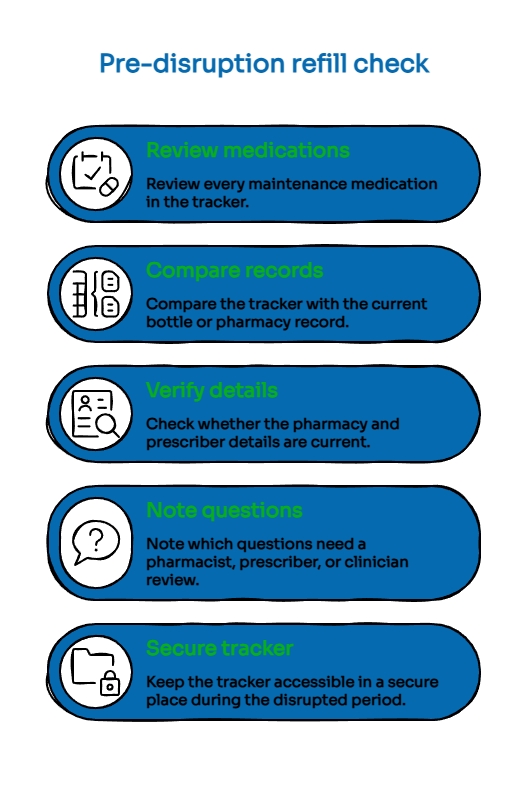
Refill organization matters most when the normal routine breaks. Before a work trip, deadline-heavy week, move, or provider transition, review the tracker while there is still time to ask questions.
Use a short pre-disruption check:
-
Review every maintenance medication in the tracker.
-
Compare the tracker with the current bottle or pharmacy record.
-
Check whether the pharmacy and prescriber details are current.
-
Note which questions need a pharmacist, prescriber, or clinician review.
-
Keep the tracker accessible in a secure place during the disrupted period.
For a workday-specific process, RefillGenie’s guide on how busy professionals can prepare for an online prescription refill during a workday may be useful.
Use Organized Details When Requesting an Online Refill
An online refill request generally works better when medication and health-history information is accurate. Organization can help forms get completed more carefully and clinician questions get answered more clearly. Approval still depends on eligibility and clinician review.
According to RefillGenie’s online prescription refill information, patients answer medical-history questions, a doctor reviews the information, contact may happen by text, and an e-prescription for an existing medicine may be transmitted to a local pharmacy if appropriate after clinician review.
RefillGenie states that it does not diagnose acute conditions or start new medications. It also states that certain medications cannot be refilled, including controlled substances and medications that require close monitoring. Those limits matter because online refill review is not appropriate for every medication or situation.
MedlinePlus notes that patients should tell healthcare providers about medicines, supplements, and herbs they take, and recommends bringing a list to appointments. That general principle also applies when preparing for a refill-related conversation.
Common Organization Mistakes to Avoid
Most refill-tracking mistakes happen when the tracker is treated as a one-time setup instead of a record that must be updated.
Relying on memory instead of the current label. Refer to the current prescription label or pharmacy record and record the medication name, strength, dosage form, and directions exactly as listed.
Tracking only one medication. Multiple prescriptions may have different refill dates, prescribers, and pharmacy records. Track all maintenance medications together.
Ignoring brand and generic names. If both names appear in the records, keep both. This can reduce confusion when different systems use different names.
Forgetting to update pharmacy or prescriber changes. Old contact details can make a simple refill question harder to resolve.
Letting the tracker go stale. Update it after each refill, pharmacy change, prescriber change, appointment update, or label change so the information stays useful when a refill question comes up.
Frequently Asked Questions
Which refill details tend to change most often?
Refills remaining, last fill date, next refill check date, pharmacy details, prescriber details, bottle quantity, and notes for review are the fields most likely to become outdated after a fill, appointment, pharmacy change, or care transition.
Should brand names and generic names both be tracked?
Yes, when both are available. Brand and generic names may appear differently across pharmacy labels, clinician notes, and medication information resources.
How often should a refill tracker be updated?
Update it when a prescription changes, a refill is filled, a pharmacy changes, a prescriber changes, or a new appointment affects the refill plan. Also review it before travel or schedule disruptions.
Can organized refill information help with an online refill request?
Yes. Accurate information can make forms and clinician questions easier to handle. It does not guarantee approval or eligibility.
What if medication details do not match across the bottle, pharmacy app, and memory?
Use the current bottle or pharmacy record as the starting point. If the conflict remains, confirm the detail before submitting or relying on it.
Make Refill Readiness Part of the Routine
A useful refill tracker turns scattered details from bottles, apps, portals, and memory into one record that can be checked before a refill question becomes urgent. Medication names, directions, prescriber details, pharmacy contacts, refill status, bottle quantity, and review questions become easier to find under pressure.
Check these records ahead of known schedule changes, rather than waiting until the last few pills are left. Consolidated details can make conversations with a pharmacist, prescriber, primary care provider, or refill-review clinician more efficient because the key facts are already copied from current records.
Once the information is organized, patients can check whether the medication may be eligible for a refill review.
Disclaimer: This article is for general informational and refill-preparation purposes only and does not constitute medical advice, diagnosis, treatment, travel medicine guidance, or a substitute for a licensed healthcare professional. Do not use a refill tracker to change, stop, restart, skip, split, or double medication; seek urgent or emergency care for severe, worsening, or potentially life-threatening symptoms.
Our Editorial Process:
Our expert team uses AI tools to help organize and structure our initial drafts. Every piece is then extensively rewritten, fact-checked, and enriched with first-hand insights and experiences by expert humans on our Insights Team to ensure accuracy and clarity.
By: The Refill Genie Insights Team
The Refill Genie Insights Team is our dedicated engine for synthesizing complex topics into clear, helpful guides. While our content is thoroughly reviewed for clarity and accuracy, it is for informational purposes and should not replace professional advice.