
July 26, 2026
How to Plan Maintenance Medication Refills Before Travel or Schedule Changes
📌 Key Takeaways
The author recommends planning refills before routines change, so medication access stays clear during travel or busy weeks.
-
Count Doses Early: Count remaining doses first, then compare them with travel dates, weekends, holidays, and limited pharmacy access.
-
Gather Exact Details: Record label details exactly, because medication name, strength, directions, prescriber, and pharmacy details reduce refill errors.
-
Ask The Right Professional: Contact the prescriber, pharmacist, online reviewer, urgent care, or emergency care based on the situation.
-
Treat Online Review Carefully: Online refill review may help with existing medications, but clinician approval and eligibility are not guaranteed.
-
Plan For More Than One Path: A backup plan helps when offices close, records differ, or refill timing changes suddenly.
Count, compare, gather, then ask early.
People managing maintenance medications will reduce refill stress, preparing them for the travel and schedule planning steps below.
Whether you are preparing for a work trip, a vacation, or a busy week of family plans, routine tasks often slip. Suddenly, the refill timing catches your eye: your medication may run low while your routine is interrupted.
That is when maintenance medication refill planning becomes practical, not theoretical. The goal is to prepare before the last few doses, while there is still time to check your prescription details, pharmacy access, prescriber availability, and backup options.
This article provides general educational information, not medical advice. Use it to organize the details a doctor, pharmacist, or licensed refill-review clinician may need so the next step is clearer.
Why Schedule Changes Create Refill Risk for Maintenance Medications
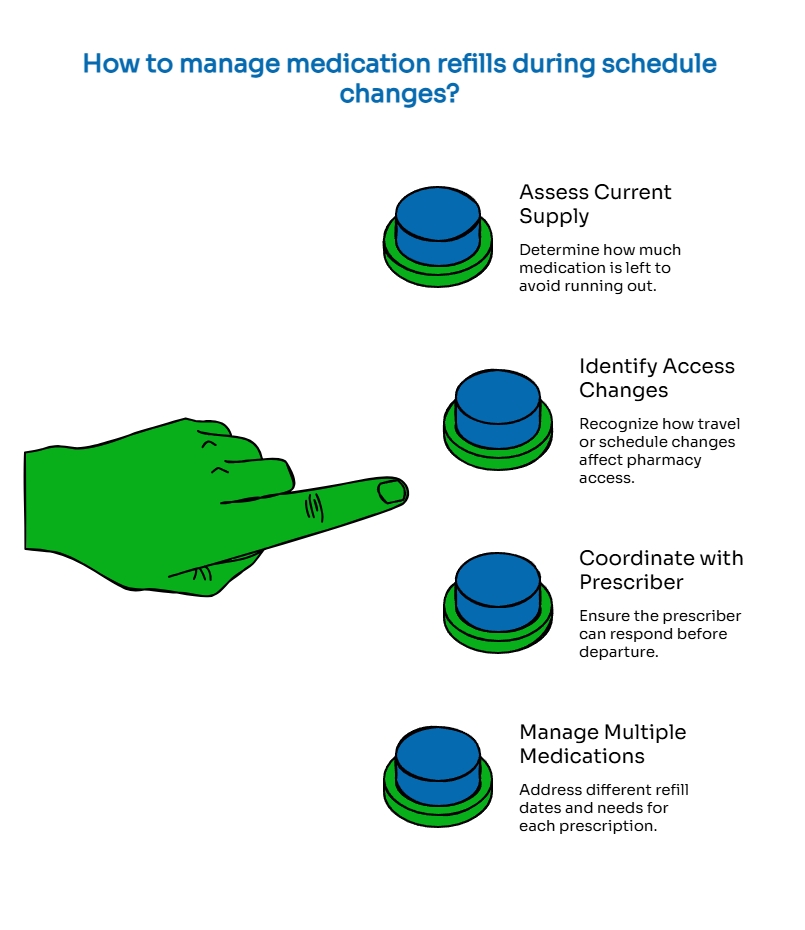
A maintenance medication is an existing prescription taken on an ongoing basis. The refill process may feel automatic during a normal week because the same pharmacy, prescriber, work schedule, and pickup routine are already in place.
Travel and schedule disruption change that. A pharmacy that is easy to reach after work may be inconvenient during a business conference. A refill window may fall during a long weekend. A prescriber’s office may not respond before departure. An insurance transition, move, or packed deadline week can also make a simple refill harder to coordinate.
This is especially true when more than one medication is involved. Different prescriptions can have different refill dates, prescribers, pharmacy records, monitoring needs, or eligibility limits for temporary bridge review.
The most useful plan starts with facts: what you take, how much is left, when access changes, and who can answer which question.
Refill Readiness Checklist Before Travel or Schedule Changes
Use this checklist early in the process, before your calendar becomes tight or your medication bottle is nearly empty.
| What to Check | What to Confirm | Why It Matters |
|---|---|---|
| Dose count | How many doses remain for each maintenance medication | Shows whether your supply overlaps with travel or limited availability |
| Medication details | Name, strength, directions, and form from the label | Reduces errors when speaking with a clinician or pharmacy |
| Refill status | Refills remaining, expiration, and last filled date if available | Helps identify whether routine refill, prescriber contact, or review is needed |
| Prescriber details | Doctor or clinic name, phone number, portal access | Makes follow-up easier if questions come up |
| Pharmacy details | Name, phone number, address, and hours if known | Helps plan pickup, transfer questions, or e-prescription routing |
| Travel or disruption dates | Departure, return, move date, deadline week, holiday, or weekend | Shows when your usual routine may not work |
| Recent changes | Dose changes, new symptoms, side effects, or missed doses | Helps determine whether professional advice is needed |
| Payment information | Insurance, discount card, or payment method if relevant | Reduces pharmacy delays after a refill is sent |
| Backup path | Prescriber, pharmacist, online refill review, urgent care, or emergency care | Keeps the next step proportionate to the situation |
A checklist is purely a preparation tool, not a promise of prescription authorization. It helps you prepare accurate information before asking for help.
Start With a Dose Count and Calendar Check
Begin with the bottle, blister pack, or pharmacy record. Count what is physically available, then compare that number with your calendar.
Avoid relying only on memory. Prescription labels, pharmacy apps, prescriber portals, and refill records are more reliable than a rough guess, especially when you are preparing for travel or managing more than one prescription.
A useful mini timeline looks like this:
| Calendar Point | Question to Ask |
|---|---|
| Today | How many doses are left right now? |
| Before departure or disruption | Is there enough time to contact the prescriber or pharmacist if needed? |
| During travel or busy period | Will the refill window fall while access is limited? |
| Return or routine reset | Will follow-up with regular care be needed? |
Consider a hypothetical example: a business traveler leaves Monday with six doses left. The issue is not only whether six doses cover the first part of the trip. The more useful question is whether the refill date, pharmacy access, prescriber response time, and travel schedule line up safely.
The CDC advises travelers to plan ahead with medications and travel documentation, especially for international trips or medications that may be restricted in some destinations. For general travel context, see the CDC’s guidance on traveling abroad with medicine.
Do not use a calendar check to decide whether to skip, stretch, double, or restart medication. If the timing looks risky, ask your prescriber or pharmacist what is appropriate for your medication and situation.
Gather the Information a Refill Reviewer May Need
A refill request is easier to review when the basic information is complete. This applies whether you contact your usual prescriber, speak with a pharmacist, or use an online refill review service for an existing medication.
Capture the details exactly as shown on the current label:
| Information | What to Record |
|---|---|
| Medication name | Brand and generic name if available |
| Strength and form | Tablet, capsule, liquid, inhaler, injection, or other form as listed |
| Directions | The label directions, not a rewritten version from memory |
| Prescriber | Name, clinic, phone number, and portal access if available |
| Pharmacy | Name, address, phone number, and current location |
| Refill history | Last filled date, refills remaining, and refill expiration if shown |
| Health context | Allergies, recent dose changes, new symptoms, side effects, or relevant conditions |
A clear photo of the prescription label can help prevent transcription errors, especially if you are filling out an online form during a busy workday. Store any photo or medication list securely because it contains personal health information.
MedlinePlus offers patient-facing guidance on keeping medicines organized, including the practical challenge of tracking multiple medicines. For a RefillGenie-specific preparation guide, review records to gather before requesting an online refill.
Having your paperwork in perfect order does not automatically result in a prescription. They help the reviewing clinician understand the existing prescription and identify what may need clarification.
Plan Differently When You Take Multiple Medications
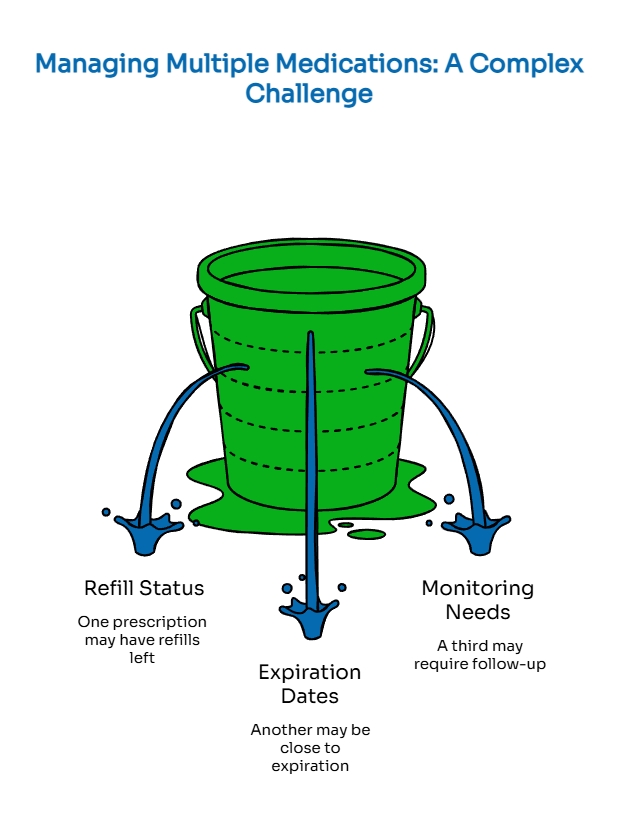
Multiple maintenance medications create a timing problem as much as a medical one. One prescription may have refills left, another may be close to expiration, and a third may require follow-up or monitoring before a refill is appropriate.
Create one simple medication list instead of checking each bottle separately. Include the medication name, strength, directions, prescriber, pharmacy, refill status, and remaining dose count. Review the list before travel, holiday weekends, insurance changes, or schedule-heavy periods.
A busy professional taking three maintenance medications may discover that only one needs attention before a trip. Another may have enough supply until after the return date. A third may require the usual prescriber because of monitoring needs or a recent change.
The value of the list is not to rank medications by importance or make clinical decisions. It is to show which questions belong with a pharmacist, which belong with a prescriber, and which may be appropriate for an online refill review if the prescription is existing and the situation fits.
What Online Refill Review Can and Cannot Do
Online refill review may be one option when you already take an existing maintenance medication and your routine access is temporarily disrupted. It is not the same as starting a new medication, diagnosing a new condition, or replacing ongoing care with your primary care doctor.
According to RefillGenie’s service page, the process involves answering health-history questions, doctor review, text contact, and possible e-prescription transmission to a local pharmacy if appropriate. RefillGenie states that it does not diagnose acute conditions or start new medications. It also states that certain medications cannot be refilled, including controlled substances and medications requiring close monitoring.
| Online Refill Review May Fit When… | It May Not Fit When… |
|---|---|
| The medication is an existing prescription | You need a new medication started |
| The request is for a temporary bridge during a care gap | You need diagnosis or treatment for a new acute condition |
| The dose and history are clear enough for review | Your symptoms, side effects, or recent changes require direct medical evaluation |
| A clinician determines the refill is appropriate | The medication is excluded, restricted, or requires close monitoring |
Eligibility depends on the medication, your history, the available information, and clinician review. RefillGenie’s guide, Online Prescription Refill Eligibility When Your Chronic Condition Is Stable, can help set expectations before you submit a request.
If you are evaluating an online option, the FDA’s guidance on how to buy medicines safely from an online pharmacy is a useful high-authority safety resource. It is especially relevant when comparing legitimate care pathways with unsafe websites that sell prescription medicines without appropriate safeguards.
To review RefillGenie’s service process, visit the online prescription refill page and check whether your existing medication may be eligible for review.
Build a Backup Plan Before Your Routine Changes
A backup plan should not depend on one perfect path. It should give you a responsible order of operations.
Start with your usual prescriber when there is enough time. Ask what the office needs, whether follow-up is required, and whether the refill status is current. If the pharmacy record does not match your bottle, ask the pharmacist to help clarify what is on file.
If your doctor’s office is closed before weekend travel, avoid assuming that a state-specific emergency supply rule applies. Pharmacy and prescribing requirements can vary by state and situation. A safer step is to ask your pharmacist about available options at your destination.
Prepare documentation before any online refill review. The less time you have, the more important accuracy becomes: current label, pharmacy address, prescriber details, recent changes, allergies, and the date when your routine access becomes limited.
Safety reminder: If you feel severely unwell, have worsening symptoms, experience concerning side effects, or believe the situation may be urgent or life-threatening, seek urgent or emergency care. Refill planning is not a substitute for timely medical evaluation.
For related travel planning, see RefillGenie’s A Traveler’s Guide: How to Manage and Refill Prescriptions While Away From Home.
Common Mistakes to Avoid
Waiting until the bottle is nearly empty is the most obvious mistake, but it is not the only one. Many refill problems come from missing details rather than lack of effort.
A few avoidable issues deserve attention:
-
Assuming travel days do not affect refill access.
-
Not knowing the exact medication strength or directions.
-
Forgetting that multiple medications may refill on different dates.
-
Treating online refill review as automatic approval.
-
Trying to use refill services for new medications or acute conditions.
-
Ignoring symptoms, side effects, or recent dose changes that require professional guidance.
The better approach is simple: count, compare, gather, and ask the right professional before the schedule disruption arrives.
Quick Refill-Readiness Recap
Before travel or a schedule change, confirm:
-
How many doses remain.
-
Whether your refill window overlaps with travel, weekends, holidays, or limited access.
-
Medication name, strength, directions, and prescriber.
-
Pharmacy name, phone number, address, and access during travel.
-
Refill status and expiration if available.
-
Recent dose changes, symptoms, side effects, or missed doses.
-
Whether a prescriber, pharmacist, online refill review, urgent care, or emergency care is the appropriate next step.
-
How you will reconnect with your regular healthcare provider for ongoing management.
Use this recap as a planning tool, not a dosing guide.
FAQs
How far ahead should medication refills be planned before travel?
Start by counting doses and comparing them with your travel dates, weekends, holidays, and pharmacy access. Exact timing can vary by medication, prescriber, pharmacy, insurance, and state rules, so avoid relying on a universal number of days. If the calendar looks tight, contact your prescriber or pharmacist early.
Can an online service refill maintenance medications before a trip?
It may be an option for an existing medication if clinician review finds the request appropriate. Authorization remains at the clinician’s discretion, and certain drug categories are strictly excluded. Online refill review should be treated as a possible bridge option, not a replacement for ongoing care.
What information should be gathered before requesting an online refill?
Gather the medication name, strength, directions, label photo, prescriber, pharmacy, refill status, allergies, relevant medical history, and any recent changes. Clear information helps the reviewer understand the request but does not ensure the request will be granted.
What medications may not be eligible for online refill?
Some medications may not be refillable through RefillGenie, including strictly regulated narcotics or prescriptions that demand regular lab work and physician oversight. Eligibility depends on clinician review, medication type, available records, and your individual situation.
What should someone do if they feel unwell after missing medication?
Contact a licensed healthcare professional, pharmacist, urgent care, or emergency services depending on symptom severity. Severe, worsening, or life-threatening symptoms should not wait for routine refill planning.
A Calm Refill Plan Protects Your Routine
Maintenance medication refill planning is not about panic or perfect timing. It is about reducing avoidable confusion before travel, work pressure, a move, an insurance change, or a gap in usual access.
Count what remains. Match it against your calendar. Gather the details a reviewer may need. Ask your prescriber or pharmacist when the situation requires professional guidance. If you already take an existing maintenance medication and your routine is about to change, gather your refill details and review whether an online refill request may be appropriate.
Disclaimer: This article is for general informational purposes only and does not constitute medical advice, diagnosis, or treatment. Readers should consult a licensed healthcare professional for guidance specific to their health, symptoms, medications, or treatment options.
Our Editorial Process:
Our content is developed to help readers understand common refill-gap situations, online refill boundaries, and temporary bridge-care options in plain language. We use Refill Genie source materials, service pages, FAQs, customer-feedback patterns, and relevant external authority sources to guide factual accuracy. Health-related content should be reviewed for clinical accuracy, eligibility language, safety limits, pricing, timing, and commercial terms before publication.
About the Refill Genie Insights Team
The Refill Genie Insights Team is our dedicated engine for synthesizing complex topics into clear, helpful guides. While our content is thoroughly reviewed for clarity and accuracy, it is for informational purposes and should not replace professional advice.