
July 26, 2026
What to Check When Your Maintenance Medication Dose or Schedule Has Changed
📌 Key Takeaways
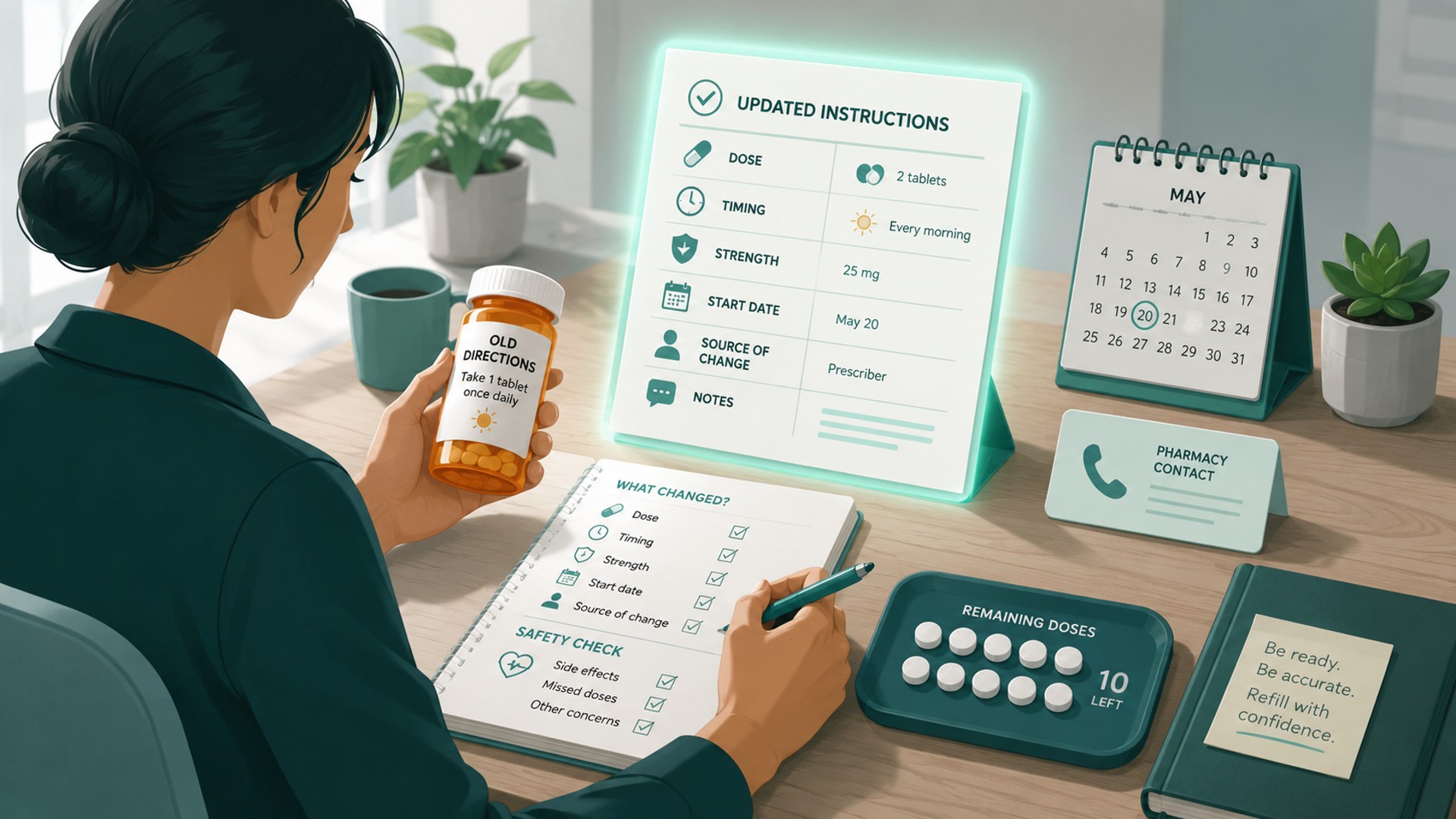
The author recommends confirming changed medication instructions before refill planning, because old labels and reminders may no longer match.
-
Confirm The Current Plan: Written instructions matter most when bottle labels, portal messages, or pharmacy records do not match.
-
Track What Changed: Record the dose, timing, strength, start date, and source so reviewers see the full picture.
-
Count Remaining Supply: Count actual doses after confirming the schedule, because a new routine can change refill timing.
-
Document Safety Concerns: Note symptoms, side effects, missed doses, or confusion so a clinician can review them.
-
Know Refill Limits: Recent, unclear, symptom-related, or monitored medication changes may need more than a routine refill request.
Changed routines need clear records, not guesswork.
Busy professionals managing maintenance medications will prepare safer refill requests, using the checklist and review steps that follow.
When a maintenance medication dose or schedule changes, the refill routine can become harder to track: the bottle may still show older directions, refill reminders may follow the previous schedule, and the remaining supply may no longer match the current plan.
Before requesting a refill review, confirm the latest written instructions and compare them with the current bottle label. Record the medication strength and frequency, count the remaining supply once the schedule is clear, and note any symptoms, side effects, missed doses, or confusion. If anything conflicts, pause and get clarification instead of relying on memory.
Changed Dose or Schedule Refill Checklist
Use this checklist to organize the information a clinician may need. It is for preparation only, not for deciding how to take your medication.
| What to check | What to record |
|---|---|
| Medication name and strength | Name on the bottle, strength, and form |
| What changed | Dose, timing, frequency, route, formulation, or written instructions |
| Change date | When the new routine started |
| Source of the change | Prescriber, covering clinician, discharge paperwork, portal message, or pharmacy clarification |
| Latest written instructions | Most recent confirmed directions available to you |
| Current bottle label | Directions, quantity, prescriber, pharmacy, and fill details |
| Remaining supply | Remaining pills, capsules, tablets, patches, injections, or doses |
| Pharmacy details | Pharmacy name and phone number |
| Safety context | Missed doses, symptoms, side effects, allergies, new medications, supplements, or confusion |
| Questions | Anything that needs clarification before review |
This checklist covers the changed-dose situation. For a fuller record-gathering process before an online refill request, RefillGenie’s documentation guide can help organize prescription details such as medication names, strengths, labels, pharmacy information, and refill history.
Start by Identifying Exactly What Changed
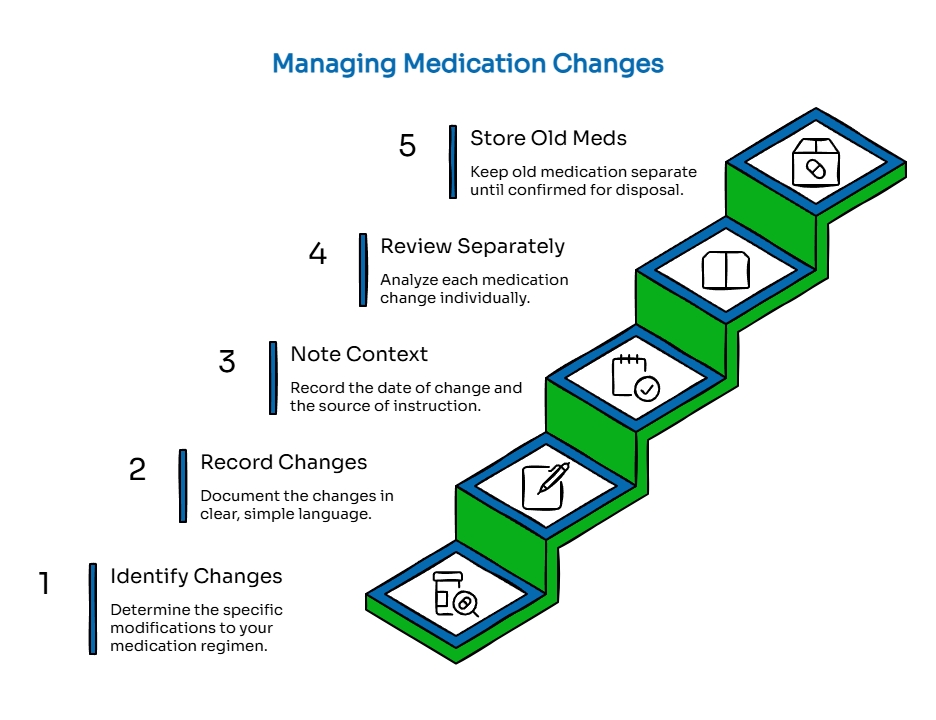
A medication change may involve more than the amount taken at one time. Check whether the update involved the dose amount, frequency, timing, medication strength, dosage form, route, or number of daily doses.
Record the change in plain language. For example, note whether the latest instruction changed the time of day, the number of daily doses, or the strength listed on the prescription. That record helps prevent an old routine from being copied into a refill request.
Also record when the change started and who gave the instruction. A portal message from a prescriber, after-visit summary, discharge paperwork, or pharmacy clarification may each provide important context. Written instructions are usually easier to review accurately than memory, especially when work, travel, or multiple medications are involved.
If more than one medication changed at the same visit, review each medication separately. One change may affect timing, while another may affect strength, quantity, or follow-up questions.
If the strength, formulation, or schedule changed, do not keep old and current doses together. Store any remaining old medication separately until a pharmacist, prescriber, or local medication take-back program confirms whether it should be used, returned, or safely disposed of. Separating old instructions from current ones reduces the chance of taking the wrong dose out of habit.
Compare the New Instructions With the Current Bottle Label
A prescription bottle label reflects the instructions available when that bottle was filled. If your prescriber changed the routine afterward, the current bottle may not show the latest directions.
The FDA describes FDA-approved patient labeling as including resources such as Medication Guides, Patient Package Inserts, and Instructions for Use. These materials can support medication understanding, but they do not replace individualized instructions from a licensed clinician.
Use a simple comparison before requesting review:
| Information source | What it may clarify | If it conflicts |
|---|---|---|
| Current bottle label | Medication name, strength, directions, quantity, pharmacy, and prescriber | Confirm which instruction is current before using it as the basis for a refill request |
| Patient portal message | Recent dose, timing, frequency, or start-date changes | Confirm unclear wording |
| After-visit paperwork | Visit-specific instructions and follow-up details | Clarify differences before relying on it |
| Pharmacy record | Fill date, quantity, pharmacy contact details, and refill history | Use as a record, not as clinical direction |
The CDC advises keeping a current list of medicines, vitamins, and supplements and taking medicines as directed on the label or by a qualified healthcare professional. If the label, portal message, pharmacy record, or written instructions do not match, pause until the current instructions are clear.
Recalculate When You May Run Out Based on the New Schedule
A schedule change can shift refill timing. Once the current directions are clear, estimate supply by counting remaining doses, not just calendar days.
Use this planning formula only when the schedule is confirmed:
Remaining doses ÷ doses per day = approximate days left
For example, a bottle with 20 remaining tablets may last about 20 days if the confirmed schedule is one tablet daily, or about 10 days if the confirmed schedule is two tablets daily. The medication strength still matters: two bottles can have the same medication name but different strengths, so include both the strength and quantity remaining when preparing information for clinician review.
This calculation is for refill planning only. Keep in mind that a significant change in dosage or frequency may require a new prior authorization from your insurance company, even if you have been taking the medication for months. Having your prescriber’s contact information handy will help your pharmacy resolve this faster. Do not stretch, skip, split, double, or otherwise change medication use to make supply last longer. If the schedule is unclear, confirm the current directions before estimating refill timing.
Note Symptoms, Side Effects, Missed Doses, or Uncertainty
After a medication routine changes, symptoms, side effects, missed doses, or unclear instructions may be important for clinician review. Write down what happened, when it started, whether it is improving or worsening, and whether it began before or after the change.
MedlinePlus provides general drug information on side effects, dosages, and interactions for prescription drugs, over-the-counter medicines, herbs, and supplements. Use authoritative resources for background learning, but route personal medication questions through a licensed healthcare professional.
Do not treat severe or urgent symptoms as a routine refill-planning issue. Possible overdose, allergic reaction, dangerous side effects, severe symptoms, or urgent mental or physical health concerns should be handled through urgent or emergency care.
Uncertainty is worth documenting. If the latest instructions are hard to interpret, if a dose was missed, or if a symptom feels related to the change, include that context instead of submitting only the old bottle directions.
Gather the Information a Clinician May Need for Review
Clinician review may depend on accurate medication details. The goal is to make the current routine clear, especially when the old refill rhythm no longer matches the latest instructions.
Gather the medication name, strength, current directions, quantity remaining, refill history, new schedule, start date, prescriber details, and pharmacy information. If a review platform requests photos of the current bottle or label, make sure the image clearly shows the medication name, strength, directions, pharmacy, prescriber, and fill details.
If an online portal has no free-text field for notes, do not force extra details into inaccurate answers. Use the structured fields as accurately as possible, upload requested label or bottle images when available, and look for a secure message, support contact, or follow-up text option where you can briefly explain the dose or schedule change. Keep the note practical: what changed, when it changed, who gave the instruction, what the current bottle says, and what question needs review.
AHRQ’s medicine-safety guide includes forms that help patients keep track of medication information and prepare questions or concerns. That same habit can make a refill request easier to review because the relevant details are already organized.
RefillGenie states that its online prescription refill process for existing medications includes health questions, doctor review, direct text contact, and, when appropriate, an e-prescription sent to a local pharmacy. This service description comes from RefillGenie’s own materials, so it should be treated as service-specific information rather than independent medical guidance.
A checklist will not guarantee approval, but it can make the current medication situation easier for the reviewing clinician to assess.
Know When a Changed Routine May Need More Than a Refill Request
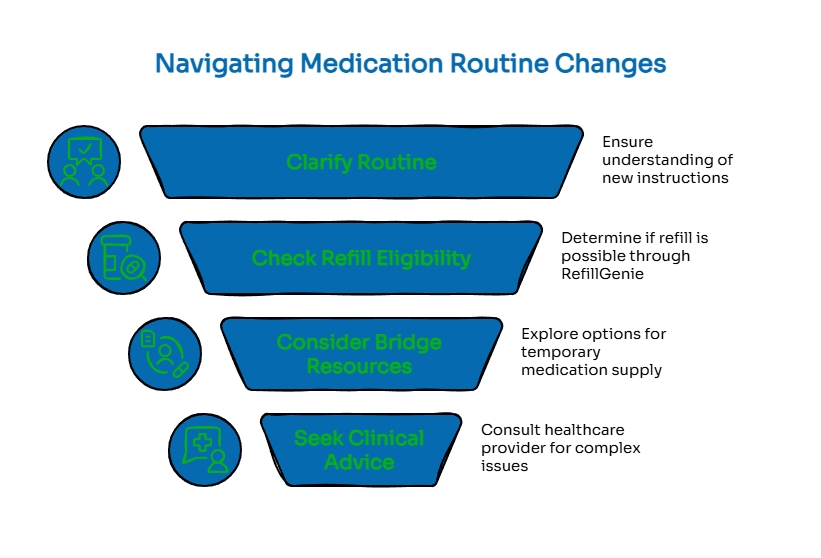
A changed medication routine is not always a simple refill issue. If the change is recent, unclear, undocumented, symptom-related, or tied to monitoring needs, clarify the current plan before submitting it as a routine refill request.
RefillGenie states that it does not diagnose acute conditions or start new medications. RefillGenie also states that certain medications cannot be refilled, including controlled substances and medications requiring close monitoring. These are RefillGenie service boundaries, not universal rules for every healthcare setting.
This distinction matters when a refill request is being used during a workday, travel, insurance gap, or provider-access gap. A bridge resource may help in some existing-medication situations, but it should not replace clarification of confusing instructions or urgent clinical concerns.
For comparison, RefillGenie’s guide on Online Refill Eligibility When Your Chronic Condition Is Stable explains a different situation: a stable routine. A changed routine deserves extra preparation because the old refill pattern may no longer describe the current prescription accurately.
Common Questions After a Dose or Schedule Change
Can I request a refill if my dose recently changed?
Maybe. Clinician review may require the latest written instructions, the start date, the reason for the change if known, current supply details, and any symptoms or side effects. Do not assume a changed-dose situation is automatically eligible or ineligible for online review.
What if my bottle label does not match what my doctor told me?
Do not guess. If the bottle label and latest prescriber instruction conflict, confirm which directions are current before taking the next dose or submitting a refill request.
When is this more than routine refill planning?
It may need more than routine refill planning when symptoms are severe, instructions conflict, the change is undocumented, monitoring may be needed, or the medication category is not appropriate for the review pathway being considered. Urgent or concerning symptoms should be directed to urgent or emergency care.
A Practical Next Step for Busy Professionals
To finalize your preparations, compile your updated medical paperwork, your current pill count, the contact details for your prescriber and pharmacy, and any unresolved questions. If information conflicts or symptoms are concerning, use the appropriate level of care, such as the prescribing office, pharmacy, urgent care, or emergency services.
If your medication is an existing prescription and your information is ready, you can review online refill options for existing medications. For broader workday planning, see RefillGenie’s guide on how busy professionals can prepare for an online prescription refill during a workday.
Disclaimer: This article is for general informational purposes only and does not constitute medical advice, diagnosis, or treatment. Medication dose or schedule questions should be reviewed with a licensed healthcare professional, prescriber, or pharmacist. Seek urgent or emergency care for severe symptoms, possible overdose, allergic reaction, or any urgent medical concern.
Our Editorial Process:
Our content is developed to help readers understand common refill-gap situations, online refill boundaries, and temporary bridge-care options in plain language. We use Refill Genie source materials, service pages, FAQs, customer-feedback patterns, and relevant external authority sources to guide factual accuracy. Health-related content should be reviewed for clinical accuracy, eligibility language, safety limits, pricing, timing, and commercial terms before publication.
About the Refill Genie Insights Team
The Refill Genie Insights Team is our dedicated engine for synthesizing complex topics into clear, helpful guides. While our content is thoroughly reviewed for clarity and accuracy, it is for informational purposes and should not replace professional advice.